1. The Automotive Industry at a Turning Point
The global automotive industry is undergoing one of the most profound transformations in its history. The rapid rise of electric vehicles (EVs), autonomous driving technologies, and advanced driver assistance systems (ADAS), combined with increasingly strict regulations on safety, emissions, and sustainability, has dramatically changed the way vehicles are designed and developed.
At the same time, market competition is intensifying. OEMs and Tier 1 suppliers are under constant pressure to:
-
Shorten development cycles
-
Reduce engineering and validation costs
-
Improve product quality and reliability
-
Launch innovative models faster than competitors
In this environment, traditional development methods that rely heavily on physical prototypes and real-world testing are no longer sufficient. They are time-consuming, expensive, and often unable to keep pace with the complexity of modern vehicle systems.
As a result, Virtual Testing has evolved from a supportive engineering tool into a mandatory approach in modern automotive development.
2. What Is Virtual Testing?
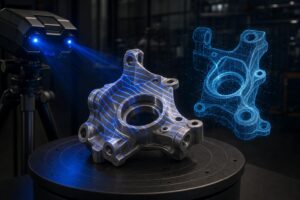
Virtual Testing refers to the use of computer-aided engineering (CAE) and digital simulation technologies to evaluate, validate, and optimize vehicle designs before physical prototypes are built.
By using high-fidelity digital models, engineers can simulate:
-
Structural behavior and durability
-
Crash and occupant safety
-
Thermal performance and fluid flow
-
Noise, vibration, and harshness (NVH)
-
Multi-physics interactions across mechanical, electrical, and electronic systems
Virtual Testing enables engineers to analyze thousands of operating conditions and design variations in a digital environment—something that would be impractical or impossible with physical testing alone.
3. Why Virtual Testing Is No Longer Optional
3.1 Faster Time-to-Market
In today’s automotive market, speed is a decisive competitive advantage. Virtual Testing significantly accelerates product development by:
-
Identifying design issues early in the concept phase
-
Reducing the number of design–build–test iterations
-
Allowing parallel design and analysis workflows
Many automotive manufacturers have reported 20–40% reductions in development time after adopting comprehensive virtual testing strategies.
3.2 Significant Reduction in Development and Testing Costs
Building and testing physical prototypes is extremely costly. A single prototype vehicle or major subsystem can require:
-
Tens or even hundreds of thousands of dollars
-
Weeks or months of manufacturing and preparation
Virtual Testing helps to:
-
Minimize the number of physical prototypes
-
Optimize designs before tooling and production
-
Reduce costly late-stage design changes
This cost advantage is especially critical in EV development, where R&D investments are rapidly increasing.
3.3 Compliance with Stricter Safety and Regulatory Requirements
Automotive safety regulations and standards such as:
-
Euro NCAP
-
FMVSS
-
UNECE
require extensive validation under numerous crash and operating scenarios. Virtual Testing enables:
-
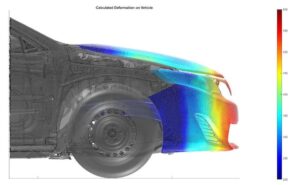
Detailed simulation of complex crash scenarios
-
Evaluation of structural deformation and energy absorption
-
Early optimization of passive safety performance
In many cases, virtual validation is now a prerequisite before physical crash tests are approved, making it an essential step in the development process.
3.4 Managing the Growing Complexity of Modern Vehicles
Modern vehicles are no longer purely mechanical systems. They are highly integrated, multi-physics systems that combine:
-
Mechanical structures
-
Electrical and electronic systems
-
Software and control algorithms
Virtual Testing allows engineers to:
-
Analyze interactions between different systems
-
Identify cascading effects of design changes
-
Detect potential failures that are difficult to observe through isolated physical tests
This capability is fundamental for the development of electric and autonomous vehicles.
4. Key Virtual Testing Applications in the Automotive Industry
4.1 Structural and Durability Simulation
-
Stress and strain analysis
-
Fatigue and lifetime prediction
-
Lightweight optimization
These simulations help manufacturers reduce vehicle weight while maintaining structural integrity and long-term durability.
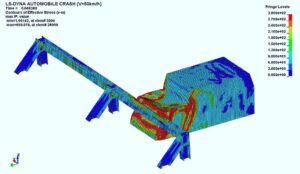
4.2 Crash and Safety Simulation
-
Frontal, side, and rear impact simulations
-
Occupant protection analysis
-
Energy absorption optimization
Crash simulation is one of the most critical and widely adopted applications of Virtual Testing in automotive engineering.
4.3 NVH (Noise, Vibration, and Harshness) Analysis
-
Structural vibration behavior
-
Interior noise prediction
-
Ride comfort and acoustic performance
NVH simulation has become increasingly important, especially for electric vehicles, where the absence of engine noise makes other noise sources more noticeable.
4.4 Thermal and Battery System Simulation for EVs
-
Battery thermal management
-
Heat dissipation and cooling system design
-
Thermal safety of lithium-ion batteries
Thermal simulation plays a key role in ensuring the performance, safety, and longevity of electric vehicles.
5. Virtual Testing as a Core Element of Automotive Digital Transformation
Virtual Testing is not an isolated activity; it is a central component of the automotive industry’s broader digital transformation. It supports and integrates with:
-
Digital Twin technologies
-
Model-Based Systems Engineering (MBSE)
-
Data-driven and AI-assisted engineering
By generating high-quality simulation data, Virtual Testing enables:
-
Predictive design optimization
-
Automated engineering workflows
-
Faster and more informed technical decision-making
In the future, the boundaries between design, validation, and manufacturing will continue to blur, with Virtual Testing acting as a unifying foundation.
6. The Importance of Engineering Partners in Virtual Testing Implementation
While the benefits of Virtual Testing are clear, effective implementation requires:
-
Deep CAE expertise
-
Strong understanding of automotive standards and processes
-
Experience with global OEM and Tier 1 projects
For this reason, many automotive companies choose engineering outsourcing partners to:
-
Scale engineering resources quickly
-
Accelerate development programs
-
Control costs without compromising quality
Selecting the right technical partner is critical to maximizing the value of Virtual Testing.
7. TAS Vietnam – Your Trusted Partner for Automotive Virtual Testing
TAS Vietnam is an engineering outsourcing company specializing in CAD/CAE and advanced simulation for the automotive industry.
We support global OEMs and suppliers with:
-
Structural, crash, and NVH simulations
-
Multi-physics analysis for electric vehicles
-
Virtual testing from concept development to production support
With a team of highly skilled engineers and strong knowledge of international automotive standards, TAS Vietnam helps customers:
-
Reduce development time
-
Lower testing and validation costs
-
Improve product safety, quality, and performance
Our mission is to deliver reliable, cost-effective virtual engineering solutions that enable our clients to compete successfully in a rapidly evolving automotive market.
8. Conclusion
In the modern automotive industry, Virtual Testing is no longer a future trend—it is a fundamental requirement. Companies that master virtual validation gain clear advantages in:
-
Speed and agility
-
Cost efficiency
-
Product quality and safety
-
Innovation capability
Investing in Virtual Testing—and partnering with experienced engineering experts—has become a decisive factor for sustainable competitiveness in the era of digital automotive development.