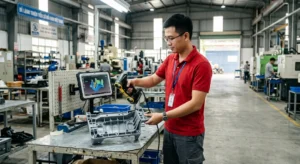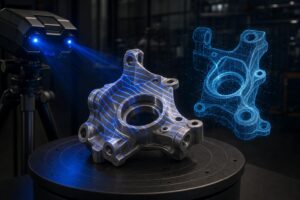
In today’s highly competitive automotive industry, precision, efficiency, and complexity are no longer optional—they are mandatory. As vehicle systems evolve toward lightweight structures, compact assemblies, and high-performance components, manufacturers must produce increasingly intricate geometries with tighter tolerances and shorter lead times.
5-axis CNC programming (5-Axis Machining Programming) has emerged as the optimal solution for machining complex automotive components with freeform surfaces, multi-angle features, and high-precision requirements. This article provides an in-depth technical analysis of 5-axis CNC programming, its strategic advantages in automotive manufacturing, and why it is a critical capability for advanced engineering service providers such as TAS Vietnam.
1. What Is 5-Axis CNC Machining?
Traditional CNC machining typically operates on 3 axes (X, Y, Z). In contrast, 5-axis CNC machining adds two rotational axes (A and B or B and C), enabling the cutting tool to approach the workpiece from virtually any direction in a single setup.
This capability significantly expands manufacturing flexibility by:
-
Enabling simultaneous multi-directional cutting
-
Reducing repositioning and refixturing
-
Improving surface quality on complex contours
-
Increasing dimensional accuracy
5-axis machining can be categorized into:
-
3+2 positional machining (indexed 5-axis)
-
Simultaneous 5-axis machining
For complex automotive components—such as turbine housings, transmission cases, cylinder heads, suspension knuckles, or mold cavities for injection molding—simultaneous 5-axis machining is often required to achieve optimal tool engagement and surface finish.
2. Why Automotive Components Demand 5-Axis CNC Programming
The automotive sector is characterized by high-performance engineering standards. Modern vehicle components often feature:
-
Organic freeform surfaces
-
Deep cavities and undercuts
-
Thin walls with structural reinforcement ribs
-
Tight GD&T requirements
-
High-strength materials (aluminum alloys, tool steel, titanium alloys)
2.1 Complex Geometries
Automotive parts increasingly integrate aerodynamic optimization, weight reduction strategies, and space-saving assembly design. These design objectives generate complex surfaces that cannot be efficiently machined with 3-axis strategies.
5-axis programming allows:
-
Continuous tool orientation control
-
Optimized tool tilt for better surface contact
-
Elimination of multiple setups
-
Access to hard-to-reach features
2.2 Precision and Tolerance Control
Many automotive components require micron-level accuracy. Refixturing in 3-axis machining introduces cumulative error. By reducing setups to a single clamping operation, 5-axis machining minimizes geometric deviation and ensures superior positional accuracy.
2.3 Surface Quality Requirements
For parts such as mold cores, cavity inserts, turbocharger components, and structural housings, surface finish directly affects performance and downstream processes.
5-axis strategies allow:
-
Constant scallop height control
-
Optimal tool vector alignment
-
Reduced tool marks
-
Shorter polishing time
3. Technical Advantages of 5-Axis CNC Programming
Advanced 5-axis CNC programming is not merely about having a 5-axis machine—it requires expertise in CAM strategy, collision avoidance, and kinematic simulation.
3.1 Toolpath Optimization
Modern CAM software enables advanced toolpath generation such as:
-
Swarf machining
-
Morph surface machining
-
Multi-axis contouring
-
Blade machining strategies
-
Adaptive roughing
By optimizing tool engagement angles, programmers reduce tool wear and improve cutting stability, especially when machining hardened tool steel or aerospace-grade aluminum alloys used in automotive performance parts.
3.2 Shorter Tool Length, Higher Stability
5-axis machining allows the tool to tilt toward the surface, reducing the need for long tool overhang. This leads to:
-
Less vibration
-
Higher spindle stability
-
Improved surface finish
-
Extended tool life
This is especially critical when machining deep mold cavities for injection molds or die-casting molds used in automotive production.
3.3 Reduced Setup Time
One of the most significant advantages is setup reduction. In traditional machining:
-
Multiple fixtures are required
-
Each repositioning adds time and potential error
5-axis machining enables complete machining in one setup, reducing:
-
Cycle time
-
Labor cost
-
Risk of scrap
4. Application in Automotive Mold and Die Manufacturing
Beyond direct automotive components, 5-axis CNC programming plays a crucial role in:
-
Injection mold core and cavity machining
-
Stamping die components
-
Progressive die inserts
-
Trim and forming dies
Complex mold surfaces require smooth, continuous motion control to avoid visible surface defects. Advanced 5-axis toolpath strategies allow:
-
Uniform scallop distribution
-
High-precision contour accuracy
-
Reduced manual finishing
For automotive mold manufacturers, 5-axis programming directly translates to faster mold delivery and improved mold lifespan.
5. Engineering Challenges in 5-Axis CNC Programming
While 5-axis machining offers significant benefits, it also introduces technical complexity.
5.1 Machine Kinematics Understanding
Different machine configurations (table-table, head-table, head-head) require customized post-processing strategies. Incorrect post configuration can lead to:
-
Axis over-travel
-
Singularities
-
Sudden axis reversal
-
Surface marks
5.2 Collision Detection and Simulation
Simultaneous 5-axis movement increases collision risk between:
-
Tool and workpiece
-
Tool holder and fixture
-
Machine head and table
High-level CAM simulation and digital twin verification are essential to ensure safe machining.
5.3 Programming Expertise
Effective 5-axis programming requires deep understanding of:
-
Cutting mechanics
-
Tool geometry
-
Material behavior
-
CAM software algorithms
Without skilled programmers, 5-axis equipment cannot deliver its full value.
6. The Strategic Role of 5-Axis CNC in Automotive Manufacturing Competitiveness
Global automotive OEMs and Tier 1 suppliers continuously push for:
-
Shorter product development cycles
-
Lighter and more efficient vehicles
-
Higher dimensional stability
-
Cost reduction
5-axis CNC programming directly supports these goals by:
-
Enabling complex lightweight part production
-
Improving machining efficiency
-
Enhancing repeatability
-
Reducing manual intervention
As electric vehicles (EVs) and hybrid systems evolve, complex battery housings, cooling plates, and structural aluminum components increasingly rely on advanced multi-axis machining.
7. Digital Integration: CAD – CAE – CAM Workflow
Modern automotive manufacturing requires seamless digital integration. 5-axis programming is most effective when integrated within a full engineering workflow:
-
CAD modeling and design validation
-
CAE simulation for stress and manufacturability
-
CAM toolpath generation
-
Post-processing and machine simulation
-
CNC execution and quality inspection
By integrating CAD/CAE/CAM environments, manufacturers reduce design-to-production lead time and eliminate costly revisions.
8. Why Engineering Expertise Matters
Owning a 5-axis machine is not sufficient. The true value lies in:
-
Advanced CAM strategy development
-
Toolpath optimization
-
Post-processor customization
-
Machine-specific parameter tuning
-
Continuous improvement through data feedback
At TAS Vietnam, we combine strong expertise in CAD, CAE, and CAM to deliver high-precision 5-axis CNC programming solutions tailored for automotive and industrial manufacturing clients.
Our engineering team focuses on:
-
Complex mold and die machining strategies
-
High-accuracy automotive components
-
Toolpath efficiency optimization
-
Simulation-driven verification
-
Cost-effective manufacturing support
Through deep technical understanding and digital integration, we help global customers reduce machining risk, improve quality, and accelerate time-to-market.
9. Future Trends in 5-Axis CNC for Automotive Industry
The future of 5-axis machining in automotive manufacturing will involve:
-
AI-assisted toolpath optimization
-
Real-time adaptive machining
-
Smart factory integration
-
Data-driven predictive maintenance
-
Hybrid manufacturing (additive + subtractive)
As Industry 4.0 evolves, 5-axis CNC programming will become even more intelligent, connected, and performance-driven.
Conclusion
5-axis CNC programming represents a transformative manufacturing solution for complex automotive components. By enabling multi-directional machining, improving precision, reducing setup time, and enhancing surface quality, it addresses the growing demands of modern vehicle engineering.
However, true optimization requires more than advanced equipment—it demands engineering expertise, simulation capability, and digital integration.
For automotive manufacturers seeking reliable, high-performance 5-axis CNC programming services, partnering with an experienced engineering outsourcing provider like TAS Vietnam ensures technical excellence, cost efficiency, and sustainable competitive advantage.